


Brand equity and pricing power: why your brand is your company’s most valuable asset

Research shows that brand equity is directly linked to pricing power. Yet many companies erode their brand through tactical short-termism and a cycle of discounting. Pricing power helps explain why investing in your brand is also an investment in better margins.
Let’s start with a visual puzzle.
Which of the smaller squares below is darker?

Just a quick glance can make the squares look different, even though they are exactly the same colour. It’s an optical illusion.
However hard we try, our eyes don’t judge the smaller squares in a vacuum but in relation to their background. Researchers call this the framing effect. It also plays a central role in how we make decisions.
That said, the point of this article isn’t to delve into how our visual perception works. I’m using the graphic as an example because it aptly illustrates the relationship between a product and a brand.
Now imagine that the inner square is the product. The outer frame is the background that gives the product its context and value. In other words, the frame is the brand.
Try again. How do the squares look now?
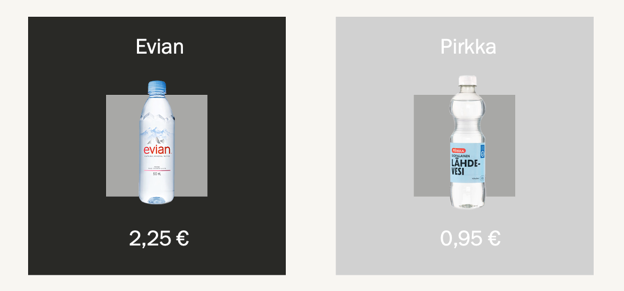
The squares are still identical. Yet the frames surrounding them have a significant impact on how valuable the product feels and appears.
Paying hurts all the way to the brain, but a brand eases the pain
In his book, Decoded: The Science Behind Why We Buy, Phil Barden, uses the framing effect to describe the impact of brands.
In his book, Barden also mentions a study in which participants were given decaffeinated coffee. Even so, their heart rate went up because they were told that the coffee brand they were served contained caffeine.
In other words, a product’s frame – its brand – can create such strong expectations in us that they even have physical effects we aren’t aware of. A strong brand works like placebo caffeine.
Our brains don’t have a separate buying mode. Instead, they are constantly weighing pain against reward. A groundbreaking study of this phenomenon is the 2007 experiment led by Professor Brian Knutson. The neuroscientific experiment showed that simply seeing a price activates a region of the brain that responds to physical and social pain.
So even the mere thought of paying – of handing over money – hurts.
When we perceive a brand as valuable enough, our brains tolerate a higher price and therefore more pain. The added value a brand brings is the amount a consumer is willing to pay purely for the frame the brand creates. It is the feeling of reward that our brains associate with the product.
So not even the strongest brand can eliminate the pain response associated with paying. However, a strong, well-known brand can increase the sense of reward so much that the brain tolerates more pain.
In other words: the stronger the brand, the less it hurts to pay for it.
Brand equity is a company’s most valuable asset
Framing also helps us understand brand equity, because as a concept a brand is entirely intangible and therefore hard to grasp. Brand equity is the value that remains in the equation once you remove the product itself, the commodity.
For example, in its 2021 annual report, The Coca-Cola Company valued its intangible assets – its brands and trademarks – at more than three times its tangible assets, such as factories and property.
Research company Kantar points out that brand equity isn’t just any abstract perception. It is the sum of attitudes and experiences formed in the consumer’s mind, which ultimately translates into a willingness to pay more for a product. That is precisely why brand equity is such a valuable asset for a company.
Kantar defines brand equity even more precisely through its Meaningfully Different framework. According to the framework, brands perceived as both meaningful and different are able to charge significantly higher prices for their products than their competitors.
The more valuable a company’s brand equity, the stronger its pricing power. Strong brand equity protects a company from price competition and helps make consumers less price-sensitive. This allows the company to raise its prices or keep them high without hurting sales volume.
The Kantar BrandZ Most Valuable Global Brands database, compiled over more than two decades, shows that valuable brand equity – and the pricing power that comes with it – is directly linked to a company’s financial success. Companies that have built strong brand equity also recover from crises (such as inflation spikes or pandemics) up to three times faster than others.
Discount campaigns poison a brand and reduce it to a commodity
When strengthening a brand, the goal is to build the strongest possible frame – in other words, brand equity – that makes consumers willing to pay a higher price for the product.
So when a company goes down the path of discount campaigns, it undermines the very foundation of what building brand equity is all about. A discount campaign tells consumers: don’t buy our product for any reason other than that it’s cheaper now than before.
Of course, the idea of a sales campaign is extremely tempting. It leads to immediate spikes in demand that look great on the sales dashboard. Unfortunately, that same dashboard doesn’t show that discounts are slowly but surely poisoning the brand.
Discounts don’t just eat into margins; they also reduce the brand to a commodity. They shrink and weaken the very value frame that was so painstakingly built – the one that makes consumers willing to pay more for the “grey square”. The brand is then reduced to a mere commodity.
Les Binet and Peter Field reach the same conclusion in their classic study The Long and the Short of It. Their data shows that long-term brand building delivers greater returns for a company than purely tactical campaigns aimed at sales activation. The explanation lies in brand equity: it enables both volume growth and better margins at the same time.
Constant discount campaigns teach consumers that there will always be another one later
Constant discount campaigns also teach consumers to wait for them. Recurring sales work like frequent commuter trains: it doesn’t matter if you miss one, because another will pull into the station very soon.
Research by the Ehrenberg-Bass Institute has also shown that price promotions do little to attract even new buyers. Much of the discount campaigning targets customers who would have bought the product later anyway – but at full price.
When Indoor Group, the chain that owned the furniture stores Asko and Sotka, filed for bankruptcy this spring, retail analyst Arhi Kivilahti singled out the chain’s constant sales in an interview with Iltalehti. In the article, Kivilahti notes that Asko and Sotka effectively ruined their brands with never-ending discount campaigns.
In the interview, Kivilahti says:
“It’s often said that starting discount sales is a bit like drugs – it’s really hard to quit.”
The story of Asko and Sotka should serve as a cautionary tale for all marketers.
At the same time, I feel there’s still a bit too much negativity around marketing in Finland. That’s why I’d also like to highlight a positive Finnish example of a brand’s pricing power.
In August, the publication Kaupan tila covered the situation of the Finnish footwear brand VIBAe. VIBAe, whose largest market is now the United States, has among other things multiplied its advertising budget and is seriously focused on long-term brand building.
From the perspective of brand equity and pricing power, Kaupan tila mentions an interesting detail about VIBAe. The article states:
“Part of the reason for the brand’s popularity is the protection of its brand value. VIBAe hasn’t held a sale in six years. According to the founders, if a classic product sells all year round, there’s no reason to suddenly sell it at half price.”
Nothing more to add.
A data-driven brand strategy helps grow brand equity in the right direction
As a concept, a brand feels fluffy – and it isn’t a tangible thing, after all. That may be one reason why investing in the brand still isn’t seen as credible in many companies.
However, research shows that long-term brand building is directly linked to pricing power. The stronger a company’s brand, the more valuable its brand equity – and the higher its returns.
So the data exists. Now we just need to do the right things by the book, right?
Well, wouldn’t that be nice. But in my entire career, I’ve never seen a moment where research alone led to smarter decision-making.
Organisations vary a lot in their marketing challenges, but most have one thing in common: the problem isn’t a lack of data or technology, but leadership – and the fact that marketing and finance speak different languages.
If you’re a marketer, you may well think that everything in this article makes sense. But at the same time, discouraging questions come to mind, such as:
- Yes, but how do I present and justify these same points to business leaders who don’t understand what a brand is really about?
- Yes, but how do I draw a clear line from our brand to our business goals?
- Yes, but how can I use numbers to prove that investing in the brand is worth it?
Our job at Dagmar is to help marketers answer exactly these questions. We help marketers build research-based arguments they can confidently present to management.
Our range of solutions includes, for example:
- Data-driven brand strategy, which brings brand and sales closer together and helps justify brand investments in the language of business
- Category Entry Point research, a study of need states that helps you target your brand’s marketing at the situations where consumers’ purchase intentions arise
- Brand development measurement, which helps verify the impact of brand investments on the business in both the short and long term
Want to take the first step towards a situation where marketing and business leadership understand each other better? Get in touch and let’s talk!
AUTHORS


Tutustu vastaaviin artikkeleihimme
-
 All-encompassing peak yearsThoughts on how the brand meets people living in a busy world and how to take into account our pressured time in strategy work.Read the blog