


What does AIO’s entry into Google Finland mean for websites?

At the beginning of May, the most significant change in a decade took place at Google in Finland. The long-awaited AIO was included in the search results. AIO, or AI Overviews, is a feature based on generative AI that summarizes the answer to a search question directly on the search results page. Our SEO expert Jussi-Pekka Kettunen tells us what to expect and how marketers should act now.
During the test phase, the new feature was known as SGE, or Search Generative Experience. The name AIO became established when the feature was introduced more widely.
The first launch to the general public was made in the USA already in May 2024.
In select European countries, the feature was introduced in March 2025.
At Dagmar, we have been following the change in the application process closely. You can read our insights in this article, for example: How to Succeed in SEO in the Age of AI.
How AIO responses are displayed
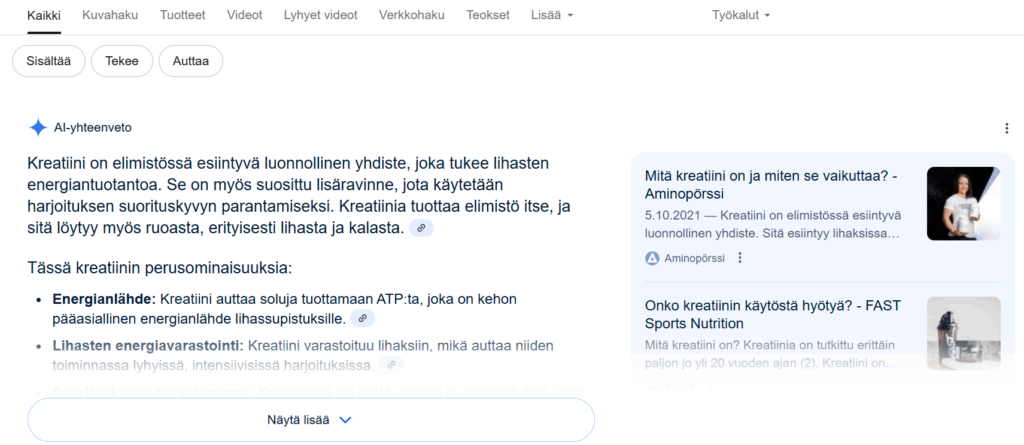
First, an excerpt from the AIO answer, i.e. an AI summary, opens up in the search results.
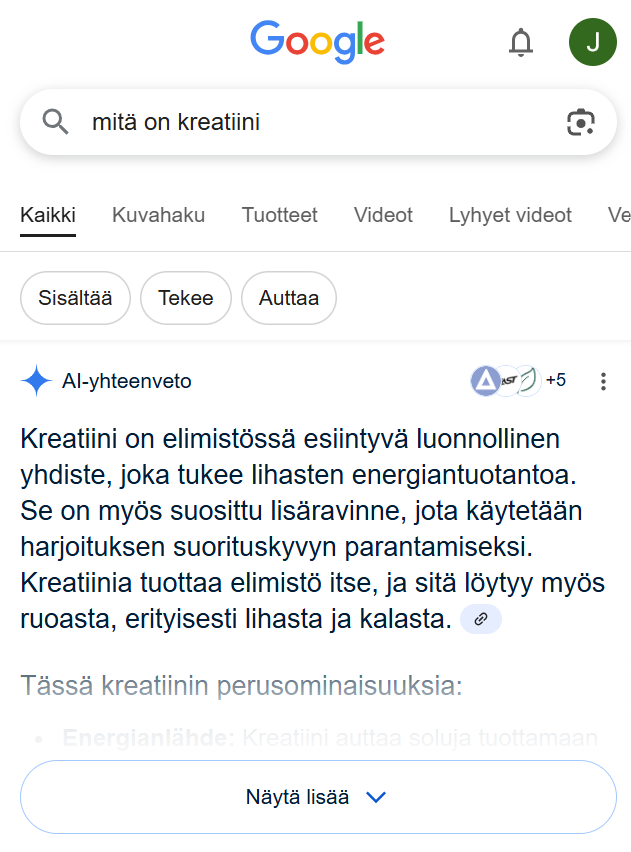
By tapping the Show more button, you can read more about the topic.
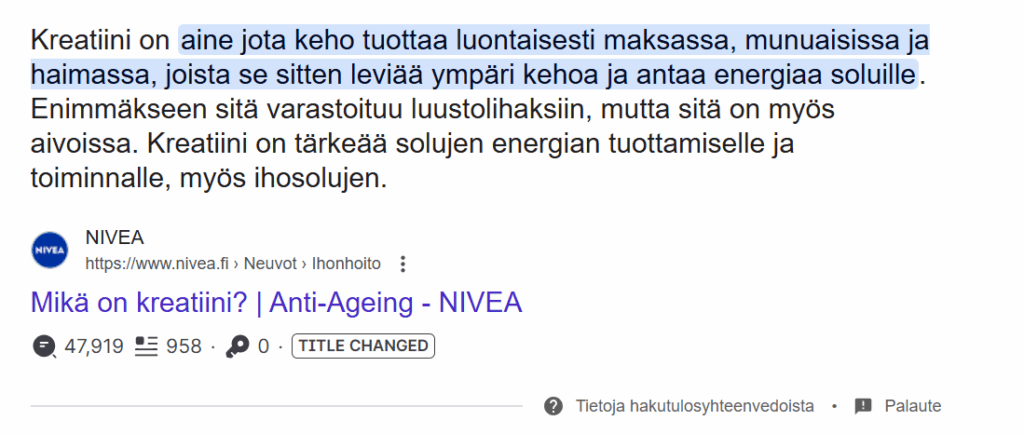
Further down is the traditional featured snippet, i.e. a fragment of the answer “what is creatine”.
The sources used in the AIO response can be found next to the AI summary text. When you click on the icons (favicons) of the websites, you can go to the content behind them.
We strongly assume that well-known brands take the lion’s share of clicks in AIO responses.
AIO revolutionizes search results – here’s how to make sure your content is seen
- The zero-click phenomenon is accelerating.
When you get the answers directly from the search results, you don’t have to go to the website. When AIO produces the responses, Ahrefs estimates that the first place will receive 34.5 percent fewer clicks than at present. The appearance of the brand in AI responses leaves a memory trace and often leads to brand searches, where the user searches for more information with the brand name.
In this case, the importance of the front page is emphasized: it must be search engine optimized and convincing. This analysis shows how AI visibility can significantly increase front-page traffic. - AIO responses are most likely to appear in informational searches.
If a website’s content strategy is built on how-to articles, it can be assumed that the amount of traffic will decrease. Now is the time to expand to other channels, such as YouTube. - The basics of SEO must be in order.
Technical SEO of the site is important. Critical success factors include:
– clear and logical content structure (semantics)
– correctly written code (HTML)
– structured data
– server side rendering, which is especially important for JavaScript-based pages, as AI and search engines don’t always see the content generated by JavaScript
– efficient use of caching, which makes pages load faster - The questions must be answered clearly.
When you answer questions in the form of [topic] is [answer], you have a better chance of rising to the answers of AI tools. A clear content structure, logically progressing headings, and the use of lists also facilitate the work of generative AI.
At Dagmar, we have powerful tools for monitoring brand visibility in both AIO responses and other AI tools.
Contact us when you want to develop your website to be AI-friendly!
See our search engine marketing services.
AUTHOR

Head of SEO
jussi-pekka.kettunen@dagmar.fi
LinkedIn
Head of SEO, Jussi-Pekka, is an economist who has become obsessed with SEO and climbing. His free time is also spent learning photography and image editing.
Read more of our articles
-
 Dagmar study: The number of AI searches doubled – search behaviour has become fragmented into multiple channelsMarketing agency Dagmar’s recent Multichannel Search survey reveals how strongly the search behaviour of Finns…Read the news
 -
 What does AIO’s entry into Google Finland mean for websites?At the beginning of May, the most significant change in a decade took place at…Read the blog
 -
 Vattenfall’s B2B website is clearer and more readableThe collaboration between Dagmar and Vattenfall‘s B2B marketing Energyplaza started already in November 2023. We…See our work